The remake of Trials of Mana has been released, and apparently has some changes made such as adding auto-targeting that make it easier to play on a phone. Controller support, however, has been removed. The game takes up quite some space on a phone, so make sure you’ve got room! The price for either download is $23.99
It has info on what foods do what, as well as how pets naturally grow over time. That way you can plan out how you want to raise your pet. If you want to know where to find eggs, that’s over on the Monsters – Eggs and Drops page.
Right now there is only a special Polter Box diet on the page, but maybe I’ll add more as time goes on. Polter Boxes are everyone’s favorite, so I thought it should be included.
In the Legend of Mana Card Duel section of the site (It will get its own area on the menu sometime soon) you can now read some information about the methods with which players would get cards.
The Booster Packs page has very little information, because despite owning a number of them I have never opened one and don’t actually know what to expect! I did include some nice images of the sides of a booster pack and a booster pack box.
The Starter Decks page has a ton of information on the other hand. It has some nice images of a starter deck, but also goes way in-depth talking about what comes inside these decks. By watching some old videos of myself opening these, I was able to determine some interesting things: 1) there are at least two types of starter decks and they come with different amounts of certain cards, 2) cards are put into the starter decks in specific orders so it’s easy to know what is coming up next, and 3) there appear to be some cards that will never show up in a starter deck. So, if that is the case, how did I complete my collection without opening booster packs? Well on this page you can follow along and see what cards I got when and how I got them.
Maybe someday in the future I’ll open some booster packs and starter decks and record it, if anyone is interested.
Look forward to more Legend of Mana Card Duel information in the future!
Comments Off on Legend of Mana Card Duel – Starter Decks and Booster Packs
Legend of Mana wasn’t the only Seiken Densetsu game to get a card game! These games aren’t anywhere near as collectable or complicated as Card Duel is, but it’s still fun to see.
Back in 1995, the Prologue book for Seiken Densetsu 3 came with a collection of 22 cards that you could play simple little games with. One game is like War, the other one is more like Uno.
You can read about the games on the Triangle Story Card Games page, and check out all the scanned cards either there or in the Gallery.
I actually scanned all those cards in back in 2012. That’s when I originally made this page, but it got lost when we transferred everything to WordPress. I think it looks pretty nice, all the images on the page are brand new.
Comments Off on Seiken Densetsu 3 Triangle Card Games
If you look to the bottom right of our sidebar while on the main page, you’ll find two new Affiliates listed.
Secret of Mana: Redux – It’s the nice Secret of Mana page that Kassidy posted about a while earlier. Since that post, quite a number of new scans have been added to the site. Check out the Lore ➔ Print section on the site for those. You can find some neat art you’ve probably never seen before on the site! Take for instance the yelling Randi and Rabite on the side there, isn’t that fun? I’ve been helping out a bit with some translations there, actually. The site aims to find out everything it can about Secret of Mana’s development.
The Mana Series Discord – a Discord server where you can discuss the Mana series games, and other things, with other fans! I started chatting there recently and met a few familiar faces! It’s not really an affiliate, per se, but I think the link fits nicely over there.
Comments Off on New Affiliates – ManaRedux & The Mana Series Discord
So the 30th year anniversary presentation was today, and I totally missed it. You can watch the recording here.
I’ve got a brief little summary here though, but I’ll try to get something more informative later.
Trials of Mana will come to smart phones (iOS & Android). A new game, Echoes of Mana is coming as a free to play game on smart phones as well. It seems to feature characters from the various Mana games. You can check out a video in English by clicking here. It doesn’t show the combat in this video, but it looked kinda hands off.
The original fonts from Legend of Mana on Playstation will return into the remaster. I don’t know if this means just fonts, or also original translation. Also, the Ultimania book will come as an e-book, but I imagine that’s only in Japanese, considering how dense that thing is! There are some Legend of Mana LINE stickers now.
Apparently a Legend of Mana anime is coming! “The Teardrop Crystal” seems to be the title, so I guess it will go over the Jumi storyline. Supposedly, the whole reason the remaster happened was because Warner Bros. Japan went to Square-Enix to talk about pitching a Legend of Mana anime. That’s very interesting! Some of the animation seems to have been included in the Legend of Mana Remaster opening video.
Finally, a new Seiken Densetsugame is in the works for consoles. That was also stated at the 25th year anniversary, however, so not too sure about the timeline on these things.
The video also showed off some nice new merch, that’ I’ve definitely purchased. That’s all I’ve got!
Since the Legend of Mana remaster came out today, I figured there would be a lot of people ripping their hair out trying to bash all the crabs in the Summer Lovin’ quest. So in order to help everyone out, I’ve created a new page that outlines just how to get all those pesky crabs.
In total, you’re going to need to bash 32 crabs to get the job done. I’ve scanned in the maps from the Ultimania Guide and annotated what you need to do. This guide will help you with either the original game, or the remaster!
I made a post about this years and years ago now (about 14 actually, where does the time go? link here), so you may have heard of this before.
I am willing to bet, however, a lot of fans of the game still have no idea this ever existed.
6 of the 10 holofoil cards.
Legend of Mana Card Duel released in 1999 along with Legend of Mana, and the “Making of Mana” book actually has some comics with characters from Legend of Mana playing with the cards. I’ll have to scan and translate that someday.
Not actually the rarest card.
The entire set consists of 150 different cards, broken into 5 separate types: Lands (27), Monsters (40), Support cards (40), Characters (40), and Items (19). Players would build two decks, the main of which would consist of between 40 and 60 cards, with no more than 4 of each copy. The other type of deck is discussed below. Cards exist in holofoil, rare, uncommon, and common rarities. The holofoils here are unique, in that it’s essentially a separate rarity; there are only 10 possible cards that can be holofoil and they will never not be holofoil. Some of the rare cards are actually much more rare than holofoils. Another painful thing about holofoils, is that they have a lot of factory defects. I counted that around 50% of holofoils have some sort of problem with their cutting.
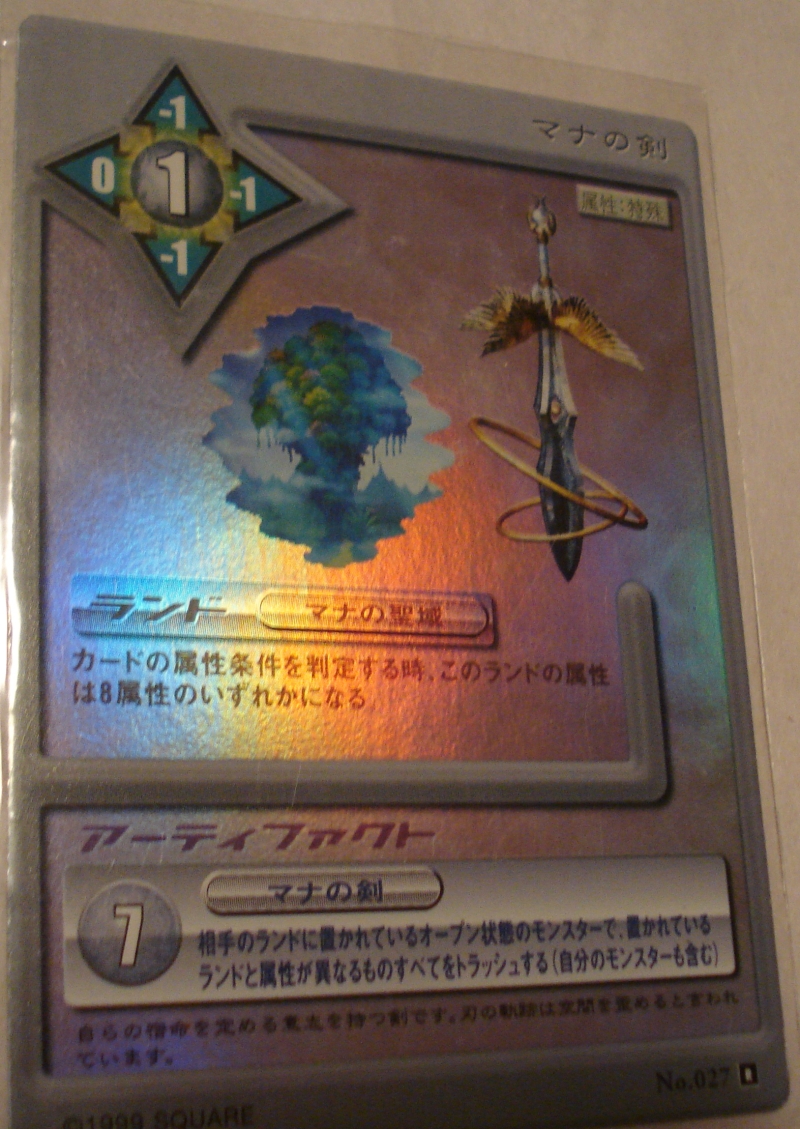
Lands exist as both an Artifact and the land they represent. A large portion of the game revolves around playing lands in a grid to mimic the land make system. In total, there are 4 lands for fire, water, earth, and wind, there are 2 lands each for wood, metal, light, and dark, and 3 other neutral lands. The breakdown of rarity is 1 holofoil, 5 rare, 9 uncommon, and 12 commons. Although, whether the lands can actually be considered “rare” is debatable (see below).
Monsters, and the regular back to cards.
Next up are the Monsters, 6 for each of fire, water, earth, and wind, and 4 each for wood, metal, light, and dark. The rarity breakdown by element is seemingly random, with some elements having more rares than others, and elements like water having no rares at all. Each one has a power and toughness level, in addition to some abilities that tend to trigger when they are flipped face up. You see, the monsters are played face down onto the lands and wander around on them, waiting for a group of characters to challenge them to battle. With some smart bluffing, you can catch a character group off guard. The rarity breakdown is 1 holofoil (a Chocobo), 12 rares (all bosses), 13 uncommons (bosses and regular enemies), and 14 commons. The art depicted on the card is typically a bunch of sprites from the game, but all the demi-human monsters have their hand-drawn art displayed.
Support cards.
Support cards are basically “spell” cards from other games. NPCs like Nunuzac may help you summon monsters, while Kathinja Sensei might straight up destroy another character. Here, a variety of NPCs offer their help to you. The NPCs follow the same elemental breakdown of the Monsters, but differ slightly in rarity. The rarity breakdown has 2 holofoils (Treant and a Lilipea), 11 rares, 14 uncommons, and 13 commons.
Character cards are very interesting in this game. They actually have a completely separate back to them compared to all of the other cards, because you would need to create a “Character deck” (of 8 cards) while playing. From this deck, you would create a team of 3 characters who can equip various items (up next) and set out to fight against Monsters on the Lands you have set up. The characters available here are quite interesting, your team could consist of something typical, like the Heroine, Niccolo, and Bud, but you could also have a team of a Rabite, Matilda, and Cap’n Tusk. Different characters have “synchro” effects with others (Skippie and Hamson make a good team for instance), and different rules about what items they can use. Here is where the rarity breakdown gets crazy. In total there are 6 holofoils (Hero, Heroine, Blackpearl, Elazul, Elle, and Sandra), 5 rares, 8 uncommons, and 5 commons.
Characters, with their unique card back, and Weapons one of the types of Items they can equip.
The final type of cards are the Items. These consist of both Weapons and Magical Instruments. There are 11 weapons (just like in the game) and 8 instruments (1 for each element, 2 of each type). These can be equipped onto a character, and using the Mana that your Lands have created, you can activate different attacks or spells to buff up your characters. The rarity breakdown goes 7 rares, 7 uncommons, and 5 commons (all weapons).
A pile of starter decks I opened.
The cards were available in two different forms: A “Starter Deck” of 60 cards and in your typical “Booster Packs” with 10 cards each. I’ve never actually opened a booster pack, although I own a number of them (and even a sealed booster box with 15 of them stored within). The starter decks aren’t really what they might seem. I opened that pile of them because they actually come with a random assortment of cards… mostly. As far as I can tell (after opening around 15 of them) every starter deck comes with the Male Hero card (making it a very common holofoil), and you seem to have a chance at getting any other card as well. There are quite a few rares I never saw when opening these decks, however, but that could just be due to sample size. The weird thing is, the starter decks come with a lot of rare land cards, to the point that the rare lands are actually more common than a lot of the uncommon ones. The only actual rare land, however, would be the single holofoil land, the Mana Sword/Mana Tree.
For those of you who want to collect the cards, good luck. They’re not that easy to come by, and purchasing singles is definitely not going to happen. There are maybe only two Japanese websites that even mention this card game, one of them is just a list of cards (with a few details wrong) and the other explicitly states the site is not for selling/trading. Typically, only starter decks show up on auction sites, and you could get away with one for about $25 on a good day. Boosters are much more rare, but I’ve paid around $15 for those. You may also find a few random assortments of cards for sale, but they tend to only include a few commons and uncommons, something that would easily be found inside a starter deck.
Let’s crack some packs. Or not. These are remaining sealed.
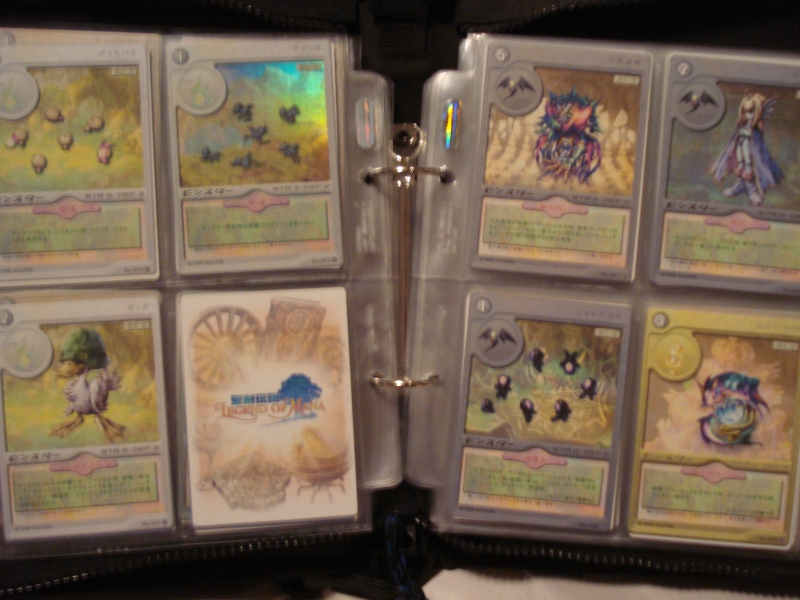
I actually have a complete set of all 150 cards, and I’m only one card away from having a second complete set (if you have a Rosiotti please let me know/give it to me). I’ve collected these cards since around 2004, and I did not complete my collection until around 2016. Overall, my entire collection is around 1500 individual cards (~680 commons, ~480 uncommons, ~270 rares, ~60 holofoils), a few unopened starter decks, a decent number of unopened boosters, and even a sealed booster box. Based on that sample, I think I have a good idea of what the rare cards are.
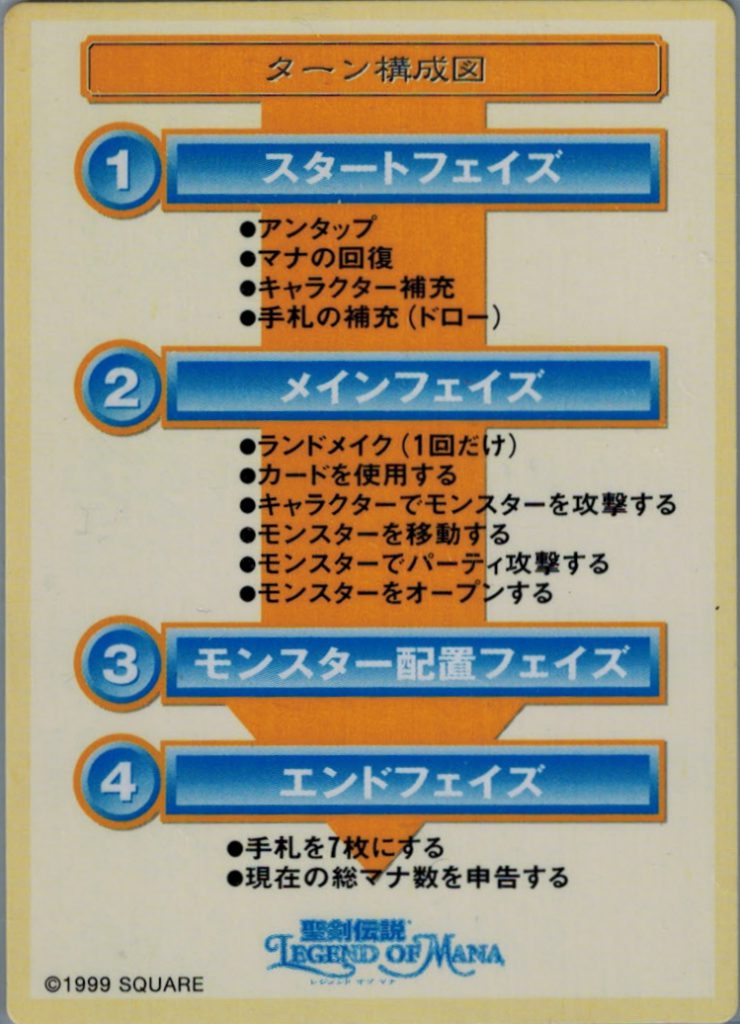
The mystery turn-order card.
Rare card seekers should look out for: #28 Hitodama, #34 DuCate, #41 Iron Centaur, #52 Vanadise, #56 Jajara, #68 Putty, #74 Rosiotti, #87 Tote, #96 Olbohn, #118 Elle, #125 Rubens, #126 Tusk, and #138 Spear (of those only Elle is holofoil). Those also happen to be cards I would love to get more duplicates of. I also have one card that I’ve got no idea where it came from. It’s a cheat-sheet for the turn-order of the game, and it has a plain white card back to it, very unprofessional seeming. Whether this came from inside boosters (never opened one) or was available at a release event or some kind of tournament, I’ll maybe never know.
Anyway, that’s my in-depth writeup about this card game that few people actually know about. I wonder how many people have actually played a game with these cards. Were there ever any tournaments back in the day? All my searching online over the years leaves me thinking that we’ll never really know.
If you want more information on the game, as well as the most in-depth and complete card list on the internet, you can check out the new page I created just for this game!
I hope to have add scans and translations for the cards and rules in the future. But seeing as this is the first page added to the website in nearly a decade, don’t be surprised if it takes a good while.