These are essentially spell cards from other card games, and each one has an NPC from Legend of Mana featured on it. Unlike the Artifact/Land Cards or the Monster Cards, which just use the names directly from the games, the Support Cards have some neat flavor to them with titles such as “Sage Tote’s Mediation”, “Professor Mephianse’s Dangerous Experiment”, “Florina’s Teardrop Crystal”, and my personal favorite “Useless Putty”.
You will notice, once again, some faces you might expect to see represented among NPC characters seem to be missing here. They’ll show up as Character cards in the next update!
To represent the “attribute condition” of each card, I made little images using sprites from in-game. I think it came out nice.
Comments Off on Legend of Mana Card Duel – Support Cards
It is quite interesting to see which monsters were chosen, and for which element as well.
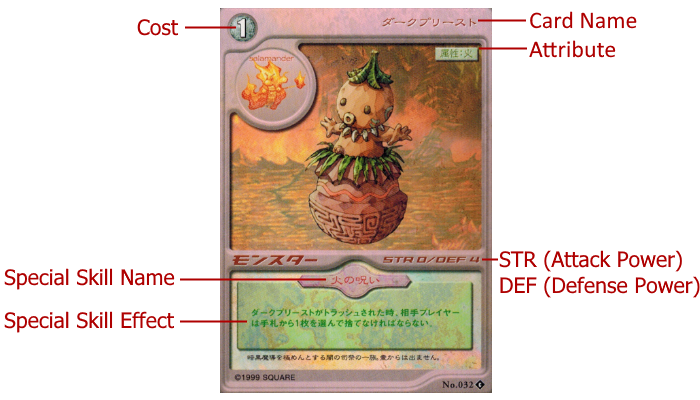
I’ve got a brief rundown of the rules for Monster cards on the page, and I’m still working on getting the full rulebook done as well (that’s likely the final of the LoM Card Duel updates). The images I use (such as the one below) to show the parts of cards are actually my updated and translated version of the images from the rulebook.
You’ll also notice that our little buddy the Rabite does not make an appearance on this page. Quite the oversight? Actually, no! Rabites have been promoted to full Character status for this game, so you’ll get to see one when I post all the Character cards.
Comments Off on Legend of Mana Card Duel – Monster Cards
What is an Aerolite? Well it’s a stony meteorite, and in Legend of Mana it includes some far out materials that you can either pick up from Shadow Zeroes, or from running around in Ring Ring Land. Here is what the game has to say about them:
Original Encyclopedia Entry
Aerolites are rocks that fall form the sky. They tend to have unusual and useful properties when used to make equipment.
Remaster Encyclopedia Entry
Aerolite refers to rocks that fall from the sky. They tend to have unusual properties that are useful when making equipment.
Just what are the unusual/useful properties they have? Well they all start with a bit of Salamander essence, and they lose one Salamander essence every time you temper them. It’s actually quite a useful effect, and you can use the energy from the drained essence to feed another essence you are trying to raise. You can even lessen the energy requirement for Salamander, and use the drained energy to feed directly back in to itself! But this isn’t a post about tempering, is it?
Whereas many primary materials in the game have names referencing locations in other Mana games (Topple Cotton and Menos Bronze as examples), the Aerolites do not follow the same naming scheme. So just where do their names come from?
Comets!
Or probably more accurately, the people who discovered them! If you are one to go down Wikipedia rabbit holes, I’ve included links to all of these comets and people below.
Jacobini Rock – The localizers for Legend of Mana didn’t seem to realize what these names were referencing, as this one should have been spelled Giacobini instead. This one references the Comet Giacobini-Zinner, and was not discovered until 1900 by Michel Giacobini and observed again three years later by Ernst Zinner. The International Cometary Explorer was sent after this one in 1985 and it was also spotted by the Pioneer Venus Orbiter the same month. In 2025 this one will be its closest to Earth.
Halley Rock – This was the one that made me realize were dealing with comets. Everyone knows Halley’s Comet! It is the only comet regularly visible to the naked eye. It actually was not discovered by Edmond Halley (being discovered in prehistoric times) but rather Halley computed its orbit in 1705. It comes around every ~76 years or so. Look forward to seeing it in 2061!
Ankh Rock – Another one that went over the localizer’s heads (get it, over their heads?). This one references Encke’s Comet, discovered by Pierre Méchain in 1786 but named after Johann Franz Encke who computed its orbit in 1819. It is a very dull comet, reflecting very little light, but like all others has a big bright tail behind it when near the Sun. It will be close to the sun in 2023, and comes around regularly as the last time was in 2020.
Vinek Rock – Here is where the localizers were the furthest from getting the name. The comet referenced here is actually the Comet Pons-Winnecke named for its discovery originally by Jean Louis Pons in 1819 and its second sighting many years later in 1858 by Friedrich August Theodor Winnecke. Initially astronomers thought this comet would strike the Earth in 1921, and it has caused a number of meteor showers by getting quite close. This one actually came by recently in May of this year!
Tuttle Rock – They spelled this one correctly! Now, this aerolite’s name could actually reference a few comets, but I’m going to reference the Comet Tempel-Tuttle. It was actually independently discovered by Wilhelm Tempel and astronomer / Civil War veteran Horace Parnell Tuttle in 1865 and 1866 respectively. This comet comes by every 33 years, and causes the Leonid meteor shower whenever it shows up. Unfortunately, we won’t get to see those sights until May 20, 2031.
Nemesis Rock – Ok, so here is the odd one out. The exception that proves the rule, as it were. This one actually references a hypothetical star that orbits our Sun and supposedly caused a bunch of extinctions (through comet like meteor showers, there is the connection!). This one is kind of weird, and worth a look.
Biella Rock – This one almost gets the name right, it should reference Biela’s Comet. This comet was identified in 1826 by Wilhelm von Biela, and it promptly split in half and has not been seen since 1852. Though it has been destroyed, it still lived on as the Andromedids meteor shower, but it seems that may have gone away as well.
Swifte Rock – Like the Tuttle Rock above, this aerolite could reference a few different comets but I’ll choose to focus on the Comet Swift-Tuttle (like the Tuttle Rock above…). This one was discovered independently by Lewis Swifte and Tuttle on July 16 and 19 of 1862 respectively. This comet causes the Pereids meteor shower, which happens yearly between around July 17 and August 24. They aren’t very visible, due to occurring between dawn and noon, but sometimes they can show up before midnight.
And there you have it! The origin of Legend of Mana’s Aerolites, and a bit of information on each of the comets/astronomers they were named for. This news post made me feel like I was writing a school report.
Also, does this mean Shadow Zeroes come from outer space? Things to think about.
Over in the Lore section of the site, there are a bunch of Print resources. There are some nice scans of interesting art (look over on the right for instance) and translations of the information in the pages. A ton of these scans have to do with the time before Secret of Mana released. It’s full of speculation and revealing brand new (at the time anyway) information about the game, it’s a great resource to see how the game came to be!
Here is what is new!
Dengeki – from this magazine you can check out a new translation in the April 1993 issue where they discuss how both Final Fantasy Adventure and Secret of Mana have the Rusty Sword in it. Famitsu – check out the May 1993 (that’s a few months before it released!) playthrough here. It’s one of the first times the game was played by people not on the dev team! Hippon Super! – here you can read about how the FFA and SoM charge systems work in the March 1993 section! Marukatsu – more FFA comparisons abound here! They’re all over in the February 93 section. Shonen Jump / V Jump – finally, just a few new images of Randi from July 93, but check out all the other neat art while you’re there!
Make sure to click around on the site, there is tons of information covering details about Characters you may not know, how different Locations changed throughout development, reviews of music tracks, and more!
Comments Off on Secret of Mana: Redux – August Update
The translations are done by me, and for the flavor text of each card I’m just using the in-game Encyclopedia entries because they are close enough. I may go back in the future and change those up, however. The page also includes some rudimentary rules and information up top, but there will be a much more fleshed out Rulebook page in the future.
Stay tuned, as in the future I’ll get sections for the rest of the cards added along with those rules!
Special thanks to Deques, for working hard on getting the CSS for the translation info set up how I wanted and putting up with my tiny nitpicks!
Comments Off on Legend of Mana Card Duel – Artifact and Land Cards
Now you can find a written guide to tempering weapons and altering armor right here on Seikens!
Marcus Majarra graciously gave us permission to host his guide on our site. I’ve updated the formatting a bit here and there, and you can head on over to the Tempering for Dummies page to learn everything you need to know about the process!
Hey, what do you mean this isn’t really “new”? Yeah, I know it’s a 20 year old guide, but it’s new to Seikens isn’t it? The information is still very in-depth and the best out there!
Well ok, if you must know, Marcus Majarra is working on an updated version of the guide, and we’ll be hosting it here in the future! Stick around for updates!
Thanks, Marcus Majarra!
Comments Off on Legend of Mana – Tempering for Dummies
To celebrate Mana's 30th Anniversary, Series Producer Masaru Oyamada and #LegendOfMana Composer Yoko Shimomura reminisce on their experiences creating both the original game and its remaster.
Was the lesson Watts gave you about forging, tempering, and altering your gear not enough for you? Still don’t understand materials, energy, tainting with elementals, and elemental consumption? Well then Malchar has got you covered!
Take 30 minutes of your time, and become a tempering expert through his video. He managed to create a weapon with 999 attack within around three hours of starting a new game, so with his guidance you can at least make something that makes you the nightmare of Nightmare Mode, and probably instill some fear into No Future as well.
Check the links in the description of his video for the tables and a forging simulator. As a bit of useful information, consider the following:
Visit Gato Grottoes and speak to the student walking around the shop area to get your fix on Fire, Earth, Wind, and Water Stones. Check out the shop before Monique’s lamp shop in Lumina to stock up on Sun, Moon, Glow, and Chaos crystals. A student at the Bone Fortress has some seeds and produce for sale. Gold Clovers can be quite useful for their high energy level, and Mush-In-A-Box are useful for Shade essence, though you’ll probably grow plenty of your own.
For some of the more important tempering materials, such as Ash and Mirror Pieces, you may need to stock up on them during a New Game (they’re limited to a few chests!) or try your luck at Ring Ring Land.
Comments Off on Legend of Mana – Tempering Explained & Example Recipes with Malchar
Courtesy of @ManaGame on Twitter, you can listen to 10 minutes of the Trials of Mana 25th Anniversary Concert.
Sit back and enjoy almost 10 minutes from the #TrialsOfMana 25th Anniversary Orchestral Concert.
Originally composed by Hiroki Kikuta and arranged for orchestra by Sachiko Miyano, the concert was conducted by Takeshi Oi and performed by the Tokyo Symphony Orchestra. pic.twitter.com/dyoEWxB7Ak
Up for preorder on the Square-Enix store, you can find three Mana Music Boxes for sale. They’re pretty expensive, and the shipping is pretty high as well, but it’s pretty cool these came to the North American Square-Enix store.
Here you can check out some short videos I took of each of them. The Domina one is by far my favorite.
You can also find some other cool Mana stuff there, if you look around. I’d recommend the Li’l Cactus Plushie, but you can also find some very expensive but very cool things.




 Visit Gato Grottoes and speak to the student walking around the shop area to get your fix on Fire, Earth, Wind, and Water Stones.
 Check out the shop before Monique’s lamp shop in Lumina to stock up on Sun, Moon, Glow, and Chaos crystals.
 A student at the Bone Fortress has some seeds and produce for sale. Gold Clovers can be quite useful for their high energy level, and Mush-In-A-Box are useful for Shade essence, though you’ll probably grow plenty of your own.